Bazzite 44.20261012 ships as latest stable build for handhelds, HTPCs, and gaming PCs
The Bazzite team put out a new stable image today. The tag is 44.20261012, built on Fedora 44, and it nudges up the graphics and gaming stack a notch while quietly fixing a bunch of stuff under the hood. Not a fireworks display. Just another in the steady stream of builds that has quietly made Bazzite one of the more practical ways to game on Linux.
If you've ever tried to make a Windows handheld or a box-of-parts gaming PC feel like a real console, you know the usual cost: driver juggling, controller remapping, display tweaking for variable refresh rates, and a constant worry that some update might break it all. Bazzite was built to erase that friction. It's a free, open-source, immutable operating system made by the Universal Blue project, and it runs on far more hardware than anything Valve ships.
The Steam Deck is great. It just isn't available to people who own an ASUS ROG Ally, a Lenovo Legion Go, a GPD, a OneXPlayer, an AYANEO, or a pile of custom-built desktop hardware. Bazzite is where that crowd goes.
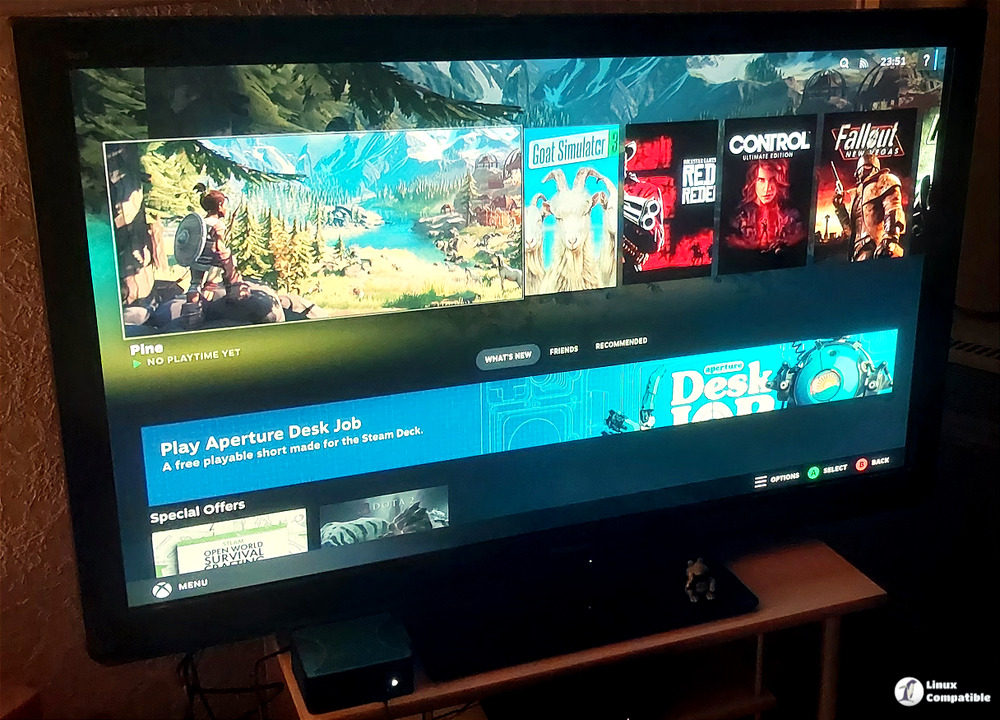
Under the hood of 44.20261012
At the center of every Bazzite release is the OGC kernel, from the Open Gaming Collective. This build pushes it to 7.2.9-ogc2.1. Mesa moves to 26.2.4, Gamescope to 3.16.31^2-1, and the Nvidia open drivers climb from 615.71.09 to 615.78.08.
The interesting pieces aren't the version numbers, though. They're in the code changes.
Bazzite's Kyle Gospodnetich and Zacharias Xenakis bundled a handful of real fixes. One trims the Steam dummy updater down to first launch only, so that background nag doesn't hang around. Another enforces the default Steam OS desktop session on Deck images and drops autologin overrides for non-Deck machines, which keeps plain desktop builds behaving.
There's also a small but telling shift toward shared packaging: Xorg, upower, and vpower now come from what Bazzite calls "Terra" packages. It's the same move Blue is making elsewhere in its ecosystem, and it means one fewer thing for the Bazzite team to maintain on its own.
Keep in mind that this is an incremental update, one package per line in the auto-generated changelog. The preceding stable build was 44.20261006.1. Following the 44.xxxxxxxx line that tracks Fedora 44. The team releases multiple builds per week during active development, so 44.20261012 is a step in a continuous stream rather than a milestone.
The stuff that actually matters to gamers
The Bazzite 44 line leans hard on VRAM management, built from work by Valve engineer Natalie Vock. It uses Linux cgroup controls (dmem / DRM device-memory cgroups) so that a fullscreen foreground game gets first dibs on GPU memory before background apps and the compositor do their thing. On low-VRAM systems, that translates to fewer stalls.
HDR and VRR ship enabled by default. LAVD and BORE CPU schedulers ride alongside the Kyber I/O scheduler for more responsive gameplay. AMD owners get an optional HDMI 2.1 stack with FRL, ALLM, and VRR, toggled through the Bazzite Portal or a single ujust configure-amd-hdmi21 command.
It's a rather thorough kit for something you install and then mostly forget about.
Why Bazzite keeps pulling
What makes Bazzite worth watching goes beyond any single release. It's a real-world test of a broader shift in Linux: immutable, image-based operating systems tuned for gaming, shipped as whole filesystem snapshots that either update cleanly or roll back from the login screen. Applications come through sandboxed Flatpak, with Distrobox for containerized tooling and an optional Homebrew. You get rollback as a feature, not a afterthought.
The OGC kernel is shared with other gaming distros like Nobara, PikaOS, ChimeraOS, and winesapOS, so hardware fixes funnel into one tree instead of everyone forking their own. Bazzite is named after a rare mineral, a nod to Fedora Atomic Desktops' habit of naming builds after stones.
How to get it
Existing users can rebase with one line:
bazzite-rollback-helper rebase stable
You can also pin this exact build:
bazzite-rollback-helper rebase 44.20261012
Because updates are atomic, a previous deployment always stays bootable, and you can pick an older image straight from the GRUB menu.
Fresh installs pull the ISO from bazzite.gg and use the Anaconda installer. You choose GNOME or KDE Plasma, with or without Nvidia drivers. There are three editions to know about: the standard Desktop build, the Bazzite-Deck variant that boots into Steam Gaming Mode for handhelds and HTPCs, and Bazzite-DX, a developer build with Docker and VS Code preinstalled.
Head here to bazzite.gg to grab the image. Or jump straight to the GitHub release page if you want to read the full changelog for 44.20261012 yourself.


