Aiursoft Limited released AnduinOS 2.1.0 today, the first 2-series build based on a non-LTS Ubuntu version, running Ubuntu 26.10, GNOME 51, and the Linux 7.3 kernel. It ships for AMD64 and ARM64 as a privacy-focused, ~2.42 GB desktop that mimics Windows 11's centered taskbar, Start menu, and Fluent design. The same fixes also landed on the LTS-based AnduinOS 2.0.6, which the studio recommends for most users and supports through April 2031. The release comes after Xue admitted earlier delays from a Secure Boot crisis caused by Ubuntu 26.10 dropping Btrfs support from its signed GRUB bootloader.
Aiursoft Ships AnduinOS 2.1.0 With Ubuntu 26.10 and GNOME 51
The Windows-style Linux desktop has a new bleeding-edge build. It also just cleared a real technical roadblock to get there.
A Windows-style Linux desktop that most people have never heard of just landed a big update. Aiursoft Limited released AnduinOS 2.1.0 today, an interim desktop built on Ubuntu 26.10, GNOME 51, and the Linux 7.3 kernel. It ships for both AMD64 and ARM64.
This is the first 2-series AnduinOS release built on a non-LTS Ubuntu version. Aiursoft is now running a two-track strategy: a stable LTS line sitting next to an "edge" build aimed at the early adopters who enjoy living on the dangerous side.
If you've followed AnduinOS for any stretch, you'll know it moves on its own schedule, and this release is proof.
For most people, though, the LTS path is the smarter bet. Aiursoft also dropped AnduinOS 2.0.6 today, layering the same desktop and recovery improvements onto Ubuntu 26.04 LTS ("Resolute Raccoon") and GNOME 50. The studio explicitly recommends that build for the everyday user.
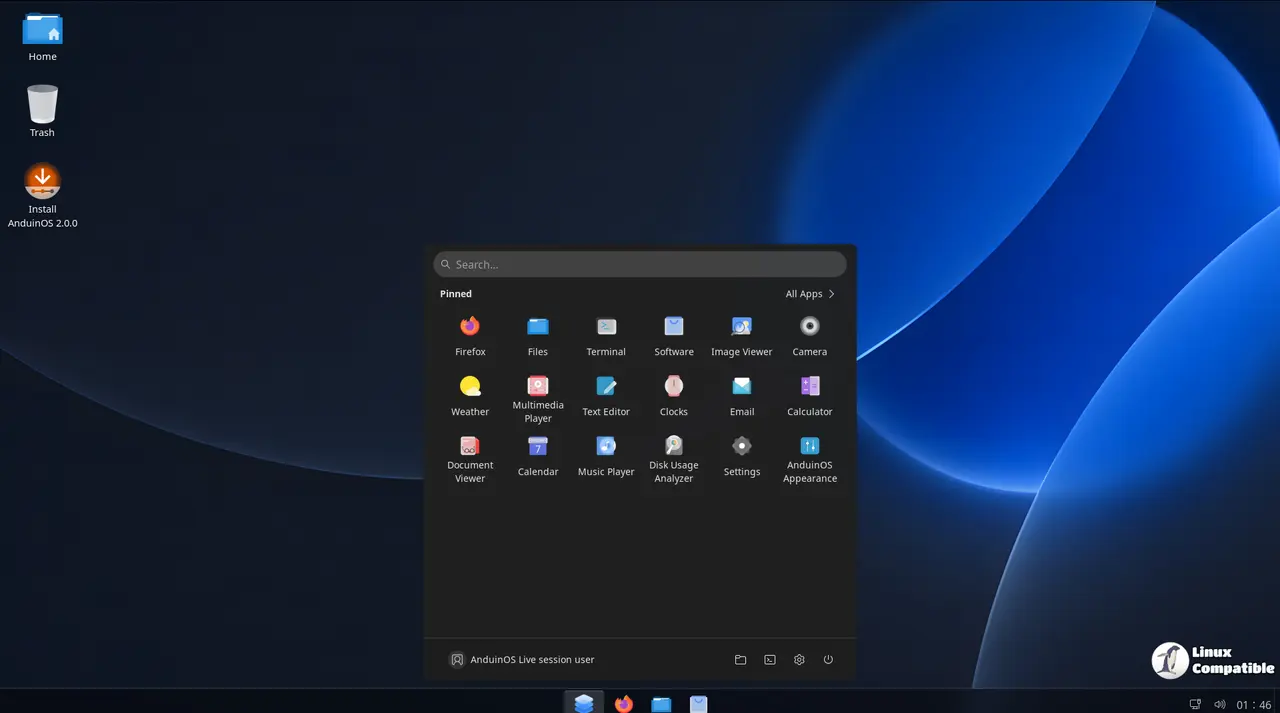
AnduinOS is a custom, Ubuntu-based distro from Microsoft engineer Anduin Xue and his company, AIURSOFT LIMITED. It markets itself as a privacy-focused, low-footprint desktop — roughly a 2.42 GB ISO — that swaps GNOME's default look for something that resembles Windows 11. Taskbar icons centered. A Start menu. Fluent design. The goal is to keep the learning curve gentle for people fleeing Windows.
Headline upgrades
AnduinOS 2.1.0 tracks Canonical's Oct. 15 release of Ubuntu 26.10 "Stonking Stingray," an interim version supported for nine months, until July 2027. On top of that base it stacks a fair amount of system software worth knowing about.
GNOME 51 brings Shell 51 and GDM 51, with the Fluent login theme and bundled desktop extensions retuned to the new session's authentication controls. The kernel jumps to 7.3, adding hardware enablement for recent silicon: Intel Xe3P (Nova Lake), AMD Zen 6, and NVIDIA 615. It also gains out-of-the-box support for the Lustre parallel distributed filesystem.
Supporting components get the same treatment. You're getting systemd 261, APT 3.3, OpenSSL 4, and dbus-broker as the default D-Bus implementation.
The base Ubuntu release carries a few extras AnduinOS inherits. Package signing is now post-quantum-ready, with GnuPG replaced by Rust-based Sequoia PGP. A migration to Rust coreutils is complete, TPM-backed full-disk encryption has expanded, and an opt-in on-device speech-to-text agent called "Myna" ships on top of local LLMs.
What's new in AnduinOS itself
Beyond the base OS bump, the release notes highlight a pile of first-party changes.
Impression replaces Startup Disk Creator as the preinstalled tool for writing ISOs to USB drives. Open an ISO, write it, done.
The biggest first-party feature is probably the independent recovery environment. A new boot-menu entry starts a separate kernel and recovery interface that can restore Btrfs system snapshots without a Live USB or a network connection. It locates the last successful boot checkpoint and lets you take a "Snapshot Current State" before rolling back. Worth knowing: the text interface only appears if graphical startup fails, and the recovery UI is English-only for now.
There's less flashy but genuinely useful work too. Driver Center can now carve a 256 MiB recovery partition out of an ordinary GPT swap partition of at least 512 MiB, walking you through installation and boot-entry repair. Offline dictation gains an optional Parakeet v3 model (TDT 0.6B INT8) for local speech recognition across 25 European languages, a roughly 631 MB download needing about 1.5 GiB of working memory. Whisper Base remains the default.
Command prediction got smarter as well. Bash suggestions now fire after sudo and shell operators. Type apt update && sudo and it can suggest apt upgrade, reusing your preferred flags from history. Accepting a suggestion inserts text. It never executes on its own, which is the part you'd hope for.
A handful of smaller touches round out the list. You can now choose Fluent or Adwaita icons, and that selection actually persists across locks and extension reloads this time. Dragging a window to the top of the screen pops up a layout menu, though it's off by default. Simplified Chinese users can pick mainland-China package servers during install. And if an Ubuntu mirror fails mid-install, the installer simply tries another verified one, signature checks still in place.
For what it's worth, this is a lot of first-party polish. But the release only makes sense if you know why it took so long.
The roadblock behind the release
This launch doesn't land cleanly without an Oct. 12 development update. That's when Xue announced that AnduinOS 2.1.0 and full-disk encryption were delayed by a genuine technical crisis. Ubuntu 26.10 removed Btrfs support from its signed GRUB bootloader. And because AnduinOS uses Btrfs by default to power its snapshots and recovery, adopting that change as-is would have left the OS unbootable under Secure Boot.
Aiursoft faced two options. Redesign the disk layout, which would have touched installation, snapshots, and recovery all at once. Or build and sign its own GRUB, which meant standing up code-signing infrastructure and possibly a Microsoft-signed shim. Both demanded time, funding, and engineering the studio said it couldn't immediately commit to.
Today's release shows the project worked through some version of the problem. The independent recovery environment and the bootloader-prep work in Driver Center look like direct responses to the boot fragility Xue described. There's a known gap, however. The recovery environment does not yet authenticate its initramfs at boot, so a fully authenticated recovery chain under Secure Boot isn't in place yet. Not ideal for the security-minded, but a reasonable stopgap.
Where to get it
AnduinOS positions itself against Zorin OS, Linux Mint, and Ubuntu with a smaller image, no Snap by default, Btrfs snapshots out of the box, native GTK4 system tools, a Wayland-only desktop, and a hard privacy stance. It sends no usage statistics or diagnostic reports by default.
It also leans heavily into an AI-native positioning, shipping Native Shell, Docker with GPU passthrough, Python, and installers for tools like Claude Code and Copilot CLI. That last bit is a stretch for a distro whose main selling point has always been simplicity, but it's a direction.
Both AnduinOS 2.1.0 and 2.0.6 LTS are available for AMD64 and ARM64 from the AnduinOS website. GitHub releases provide SHA256 checksums and Torrent files.
Keep in mind the split before you download. AnduinOS 2.1.0 requires a fresh install, and existing 2.0 users cannot APT-upgrade into it. Don't reach for do-release-upgrade or start swapping APT suites on a hunch. The 2.0.6 LTS line lets current users stay put on Ubuntu 26.04 LTS and GNOME 50 while still getting the desktop and recovery fixes through existing APT sources, and it's supported through April 2031.
Head here for the full release notes


