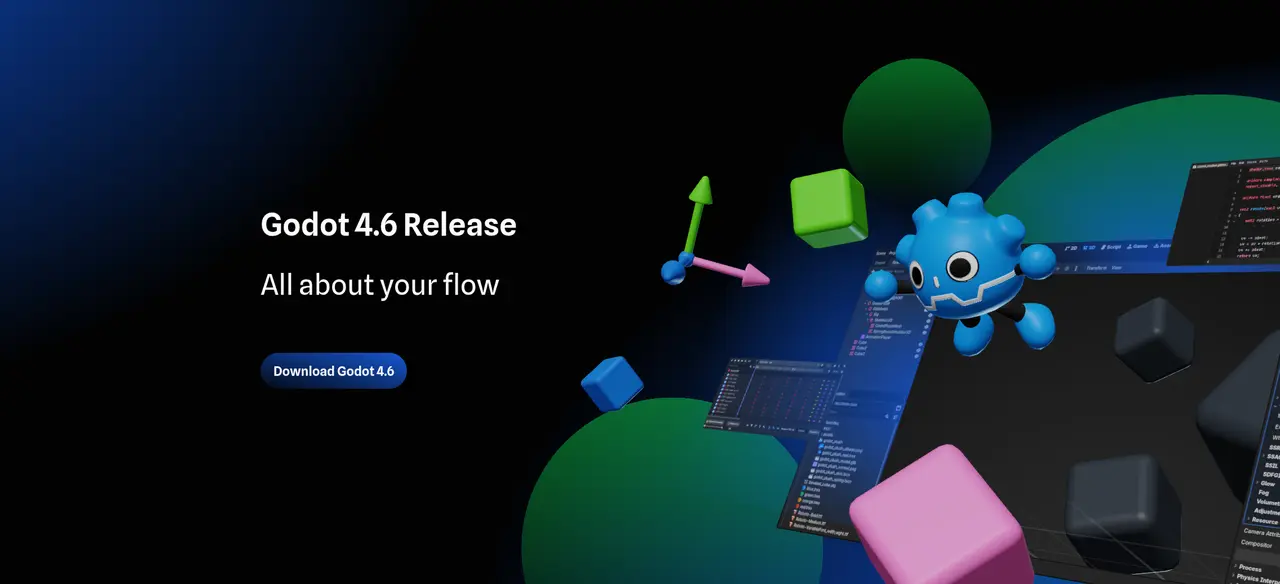
Godot 4.6 released
Godot has officially released version 4.6. It seems like the engine is getting comfortable with itself. After five previous releases focused mainly on building stability and smoothing out rough edges, Godot is now ready to tackle its next phase of development. This upcoming stretch emphasizes polish, quality-of-life tweaks, better integration with industry standards, and performance boosts.
One big change in 4.6 is a new editor theme called "Modern." It's designed to be cleaner and less cluttered for game creators. The straightforward look helps you focus on building your games rather than fighting with the interface itself. Think subtle contrast changes, clearer text, and better spacing between buttons and panels; it just aims to feel smoother and more intuitive overall.
Switching gears entirely is what happened with Jolt Physics. Once an experimental option, Jolt has now officially become the standard for new 3D projects by default in Godot 4.6. This seems to be based on real testing out there, proving its reliability alongside its strong performance. You get all of Jolt's power built right into the engine without jumping through extra hoops.
Customizing your workspace just got easier too. Version 4.6 allows you to move editor docks and panels around freely; they're "floatable." This makes tailoring the interface precisely to how you work a bit simpler, reducing some of the UI hassle involved in development.
And welcome back: inverse kinematics (IK). It's returning now in 4.6 for users familiar with earlier versions. Animators and those scripting gameplay animations should find this really handy, as it helps create fluid movements that feel natural without too much fuss.
Speaking of visual polish, Screen Space Reflections (SSR) have had a good update. The improvements push realism further while likely making things faster to boot up or run. You even get choices built-in now, like picking between full quality and saving some performance headroom if needed.
Digging deeper into how scenes are handled internally, nodes in Godot 4.6 receive unique IDs automatically. This might not sound exciting, but it helps the engine keep track of things more reliably during complex scene reorganizations or refactoring tasks down the line, a subtle but potentially useful enhancement for bigger projects.
Finally, if you're curious about using Godot's tech directly within your own applications instead of just building games, that's possible now thanks to LibGodot. The initial support covers Linux, Windows, and macOS. More platform integration is definitely planned for future releases beyond this point.
For more information, check out the release announcement below:
Godot 4.6 Release