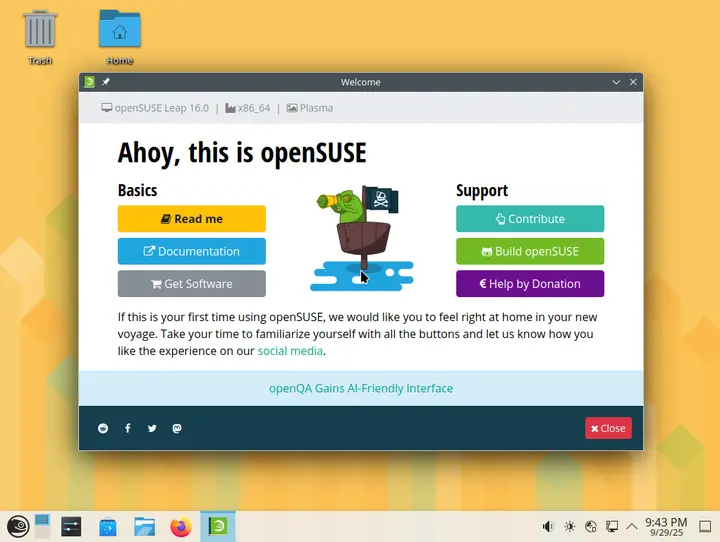
openSUSE Leap 16 has been released and is a major version update that introduces a new software stack, a long-term maintenance- and security-support cycle, and a more modern setup experience with its Agama installer. This release also features improved migration options, including the ability to seamlessly upgrade from Leap 15 or migrate to Slowroll, Tumbleweed, or SLES, thanks to a dedicated openSUSE Migration tool. With SELinux as its Linux Security Module (LSM) and support for parallel downloads in Zypper, Leap 16 offers enhanced security and streamlined software installations.
openSUSE Leap 16 released
The latest iteration of the openSUSE Leap community-Linux distribution has been officially released, which marks an important step in the evolution of this fixed-release platform. This major version update boasts an entirely new software stack and introduces a groundbreaking maintenance- and security-support cycle that will undoubtedly shape the future of open-source development. As a community-supported platform, openSUSE Leap 16 is poised to drive innovation and deliver practical solutions to real-world challenges in the years to come.
A notable aspect of this release is its commitment to long-term security and stability. The distribution has been designed with an eye towards the future, incorporating features that ensure it will remain relevant even as far ahead as 2038. Furthermore, openSUSE Leap 16 features a 32-bit support mechanism that can be enabled manually by users who wish to utilize Steam's gaming capabilities, which still relies on these libraries.
In terms of hardware requirements, this latest iteration demands at least an x86-64-v2 CPU architecture level as its minimum requirement. This essentially means that only CPUs purchased from 2008 onwards will meet the necessary criteria. Users with older hardware may wish to consider migrating to either Slowroll or Tumbleweed instead.
One of the key differentiators of openSUSE Leap 16 is its ability to seamlessly blend both community and enterprise distribution codes. By building upon the foundation laid by SUSE Linux Enterprise Server (SLES), this platform ensures that users can enjoy identical source and binary code across both platforms, with the added benefit of being able to migrate from openSUSE Leap 16 to SLES 16 without any hassle.
In addition to its technical prowess, openSUSE Leap 16 boasts a new and modern Agama installer, offering an enhanced setup experience compared to its deprecated YaST-based predecessor. Furthermore, this release supports parallel downloads in the Zypper package manager, significantly speeding up software installations and updates.
The migration process has also been streamlined with the introduction of a dedicated openSUSE Migration tool, which enables users to seamlessly upgrade from Leap 15 to Leap 16 or migrate to either Slowroll, Tumbleweed, or SLES. This user-centric approach aims to minimize disruption during the transition period.
As part of its long-term strategy, the project has committed to releasing annual minor updates until 2031 with the release of Leap 16.6, which marks a major shift in the life-cycle plan. A successor to Leap 16 is expected to emerge in 2032, while Leap Micro, the immutable server distribution from the same project, will also adopt this schedule.
This latest iteration comes equipped with SELinux as its Linux Security Module (LSM), providing users with an additional layer of security. While AppArmor remains an option that can be selected post-installation, changes to Leap related to AppArmor and 32-bit support have been implemented to provide a transition period for users.
As openSUSE Leap 16 continues to evolve towards its final release next decade, we can expect further advancements in automation, containerization, system tooling, and hardware encryption. With each passing iteration, this platform will undoubtedly continue to play a pivotal role in shaping the future of Linux development and adoption.
For more information, visit the linked announcement below:
Next Chapter Opens with Leap 16 Release