Fedora Linux 43 Release Candidate 1.5 released
The latest release candidate for Fedora Linux 43 has been made available for community members to conduct extensive testing and validation, following the decision not to proceed with the previous release candidate as the final version of Fedora Linux 43 due to several unresolved blocker bugs. Additionally, there are worries about not enough testing being done for the aarch64 architecture, which is important for making sure the operating system works well and is compatible with this type of hardware.
Additionally, the testing of the KDE Plasma edition showed only a few results, indicating that more thorough checking and fixing are necessary to make sure this version meets the high standards expected of Fedora Linux 43. As a result, the development team has chosen to release another candidate for community testing, with the hope that this additional round of evaluation will help identify and resolve any remaining issues before the final version is released.
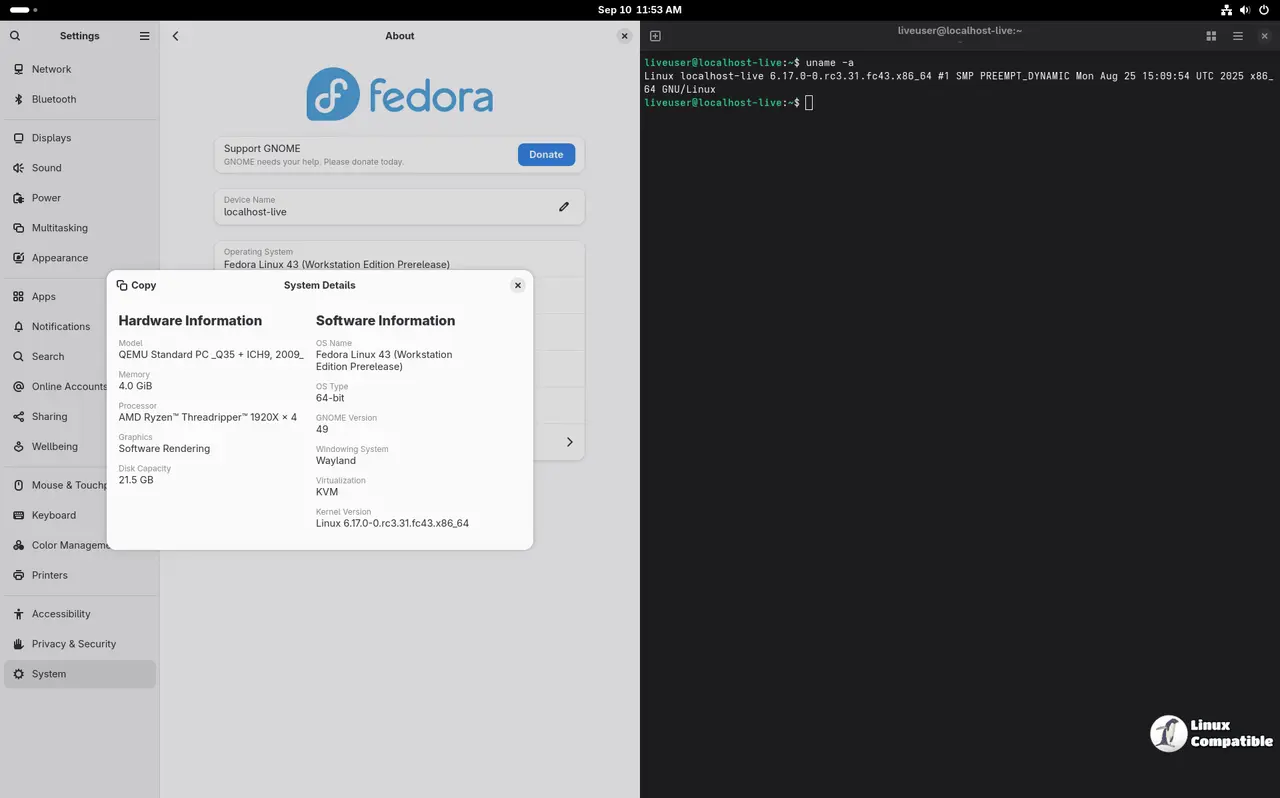
One of the most important changes in Fedora 43 is the addition of different desktop environments, each with its set of features and improvements. For example, the Fedora COSMIC Spin has hybrid per-workspace tiling management, window stacks with tabs for switching between windows, and the ability to customize things using the GTK toolkit. XFCE 4.20 has also been updated to add experimental Wayland support, which should make things work better and faster.
LXQt 2.1 is another important update. It now uses Wayland by default via miriway. This integration makes it possible for this lightweight desktop environment and Fedora Linux to work together flawlessly. Furthermore, the Fedora KDE Plasma Desktop has been promoted to full Edition status, ensuring that users can take advantage of the latest version of this popular desktop environment.
Fedora 43 has a lot of new features that are great for developers, in addition to the ones already mentioned. NASA made the Copilot Runtime Verification Framework, which makes it possible to write hard real-time C code. This framework helps developers make apps that are faster and more reliable. Ruby 3.4 has a new default parser (Prism), better performance for the YJIT compiler, and the Happy Eyeballs Version 2 socket feature, which makes it a good choice for Ruby developers.
The PHP 8.4 update adds property hooks for computed properties, independent read/write scope control, a new #[Deprecated] attribute, and new array functions, making it even more powerful as a popular programming language. GCC 15, Binutils 2.44, glibc 2.41, and GDB 15+ are also new in the GNU Toolchain. This feature makes sure that developers have access to the newest tools and technologies.
Fedora Linux 43 Beta also includes the FEX Emulator, a powerful emulator that lets you run x86 and x86-64 binaries on an AArch64 Linux host. This makes it easy for developers to test their apps. The switch from SDL 2 to SDL 3 is also in the works, with the goal of making the switch as smooth as possible and possibly improving performance.
Community members need to participate in release validation testing to make sure that Fedora 43 is of high quality. Fedora 43 Candidate RC-1.5 is now ready for testing, and users are asked to help finish all the necessary validation testing.
For more information on release validation testing, please refer to the Fedora Project wiki. Test coverage information can be found at this link. The summary page for test results and image download locations is available here.
Individual test result pages are also available:
You find the current blocker and freeze exception bugs listed on this page. For direct downloads of the images, visit this page.


